
Astrology & Numerology
Astrology is a belief system that posits a relationship between the positions and movements of celestial bodies (such as stars and planets), events that occur on Earth, and human characteristics and behaviors. It suggests that these heavenly bodies influence human affairs and natural phenomena. Astrology has been practiced in various forms for thousands of years. It is often used to create horoscopes, which are personalized interpretations based on the positions of celestial bodies at the time of a person’s birth. It is distinct from astronomy, which is the scientific study of celestial objects and phenomena.
Eastern Astrology and Western Astrology are two distinct systems that differ in their historical development, methodologies, and philosophical foundations. There are certain similarities between Eastern and Western astrology, despite their differences: Celestial Influence: According to both Eastern and Western astrology, celestial bodies like planets and stars have an impact on both earthly events and human lives. Both of them make use of these celestial positions to decipher and forecast patterns and traits. give individualized insights by utilizing forecasting methods. Both systems utilize symbols and archetypes to interpret the influence of celestial bodies. For example, both Western and Eastern astrology assign symbolic meanings to planets and use them to understand aspects of human personality and destiny.
Western Astrology: Originating from ancient Mesopotamia and later developed in Greece and Rome, Western Astrology emphasizes the positions of the Sun, Moon, planets, and constellations along the ecliptic (the apparent path of the Sun across the sky).Uses the tropical zodiac, which is based on the position of the Sun relative to the Earth’s seasons. The tropical zodiac starts at the vernal equinox (around March 21st), dividing the ecliptic into 12 equal signs of 30 degrees each. emphasizes psychological and personality analysis, often focusing on individual horoscopes based on the exact date, time, and place of birth. It includes aspects, planetary transits, and progressions in its predictive techniques.
Eastern Astrology: Originating primarily from ancient China and India, Eastern Astrology encompasses systems like Chinese astrology and Vedic astrology. Chinese astrology focuses on a 12-year cycle with animal signs, while Vedic astrology uses the sidereal zodiac and is deeply rooted in Hindu philosophy and traditions. Chinese astrology uses a 12-year cycle with animal signs (rat, ox, tiger, etc.), and Vedic astrology typically uses the sidereal zodiac, which is based on fixed star positions. Focuses on broader cycles and patterns, often applied to societal trends and events as well as individual destinies. Chinese astrology, for instance, combines birth years with elements (wood, fire, earth, metal, and water) and yin/yang principles for more comprehensive interpretations.
While their methodologies, zodiac systems, and philosophical underpinnings differ significantly, these similarities show that both Eastern and Western Astrology share a common foundation in observing and interpreting celestial phenomena to understand human experience and destiny
The Western zodiac, also known as the Tropical zodiac, is a system of astrology that divides the ecliptic (the apparent path of the Sun across the celestial sphere) into twelve equal parts of 30 degrees each. Each of these parts corresponds to one of the twelve astrological signs, which are based on constellations traditionally associated with each segment of the ecliptic. Here are the twelve signs of the Western zodiac:
- Aries (March 21 – April 19): Symbolized by the Ram, Aries is associated with traits like independence, courage, and assertiveness.
- Taurus (April 20 – May 20): Symbolized by the Bull, Taurus is known for traits such as stability, determination, and sensuality.
- Gemini (May 21 – June 20): Symbolized by the Twins, Gemini is characterized by traits such as adaptability, curiosity, and sociability.
- Cancer (June 21 – July 22): Symbolized by the Crab, Cancer is associated with traits like emotional sensitivity, nurturing, and loyalty.
- Leo (July 23 – August 22): Symbolized by the Lion, Leo is known for traits such as leadership, creativity, and confidence.
- Virgo (August 23 – September 22): Symbolized by the Virgin, Virgo is characterized by traits such as practicality, attention to detail, and analytical thinking.
- Libra (September 23 – October 22): Symbolized by the Scales, Libra is associated with traits like diplomacy, harmony-seeking, and fairness.
- Scorpio (October 23 – November 21): Symbolized by the Scorpion, Scorpio is known for traits such as intensity, passion, and resourcefulness.
- Sagittarius (November 22 – December 21): Symbolized by the Archer, Sagittarius is characterized by traits such as optimism, adventure-seeking, and philosophical thinking.
- Capricorn (December 22 – January 19): Symbolized by the Goat, Capricorn is associated with traits like ambition, discipline, and practicality.
- Aquarius (January 20 – February 18): Symbolized by the Water Bearer, Aquarius is known for traits such as innovation, humanitarianism, and independence.
- Pisces (February 19 – March 20): Symbolized by the Fishes, Pisces is characterized by traits such as compassion, intuition, and creativity.
In astrology, there are several planets (including the Sun and Moon) that are considered to have a significant influence on a person’s personality, behaviors, and life events. Each planet is associated with specific traits and energies, and they are symbolized by unique symbols or glyphs. Here are the astrological planets along with their symbols:
- Sun: Symbolized by a circle with a dot in the center (☉). Represents vitality, ego, individuality, and the core essence of a person.
- Moon: Symbolized by a crescent shape (☽). Represents emotions, instincts, nurturing, and the subconscious mind.
- Mercury: Symbolized by a symbol resembling the Caduceus (☿). Represents communication, intellect, reasoning, and adaptability.
- Venus: Symbolized by a circle with a cross below it (♀). Represents love, relationships, beauty, harmony, and values.
- Mars: Symbolized by a circle with an arrow pointing diagonally upwards to the right (♂). Represents energy, action, desire, courage, and aggression.
- Jupiter: Symbolized by a crescent above a cross (♃). Represents expansion, growth, optimism, luck, wisdom, and abundance.
- Saturn: Symbolized by a cross above a crescent (♄). Represents discipline, responsibility, limitations, structure, and ambition.
- Uranus: Symbolized by a cross above a circle (â™…). Represents innovation, rebellion, change, unpredictability, and individuality.
- Neptune: Symbolized by a trident (♆). Represents spirituality, imagination, dreams, illusion, compassion, and escapism.
- Pluto: Symbolized by a circle with a crescent and a cross underneath (♇). Represents transformation, power, regeneration, intensity, and deep psychological processes.
In Western astrology, 12 houses represent different areas of life and experiences that make up a person’s existence. These houses are divisions of the ecliptic (the Sun’s apparent path across the celestial sphere) and are defined by the time and location of a person’s birth. Each house is associated with specific themes and influences, providing insights into various aspects of an individual’s life. Here’s a brief overview of what each of the 12 houses represents:
- 1st House – House of Self (Aries):
- Represents the self, personality, appearance, and how others perceive you.
- 2nd House – House of Finances and Values (Taurus):
- Deals with personal resources, finances, possessions, values, and self-worth.
- 3rd House – House of Communication (Gemini):
- Governs communication, intellect, learning, siblings, short trips, and daily interactions.
- 4th House – House of Home and Family (Cancer):
- Represents home, family, roots, emotional foundations, and the private sphere of life.
- 5th House – House of Creativity and Pleasure (Leo):
- Governs creativity, self-expression, romance, hobbies, children, and pleasure.
- 6th House – House of Health and Service (Virgo):
- Deals with work, health, daily routines, service to others, and practical matters.
- 7th House – House of Partnerships (Libra):
- Represents one-on-one relationships, partnerships, marriages, contracts, and open enemies.
- 8th House – House of Transformation (Scorpio):
- Governs transformation, shared resources, intimacy, death and rebirth, and psychological depths.
- 9th House – House of Philosophy and Higher Learning (Sagittarius):
- Deals with higher education, philosophy, beliefs, travel, foreign cultures, and spirituality.
- 10th House – House of Career and Public Image (Capricorn):
- Represents career, ambitions, public reputation, authority figures, and life path.
- 11th House – House of Hopes and Friendships (Aquarius):
- Governs friendships, social groups, dreams, ideals, humanitarian causes, and aspirations.
- 12th House – House of Subconscious and Endings (Pisces):
- Deals with the subconscious mind, spirituality, hidden strengths and weaknesses, secrets, karma, and endings.
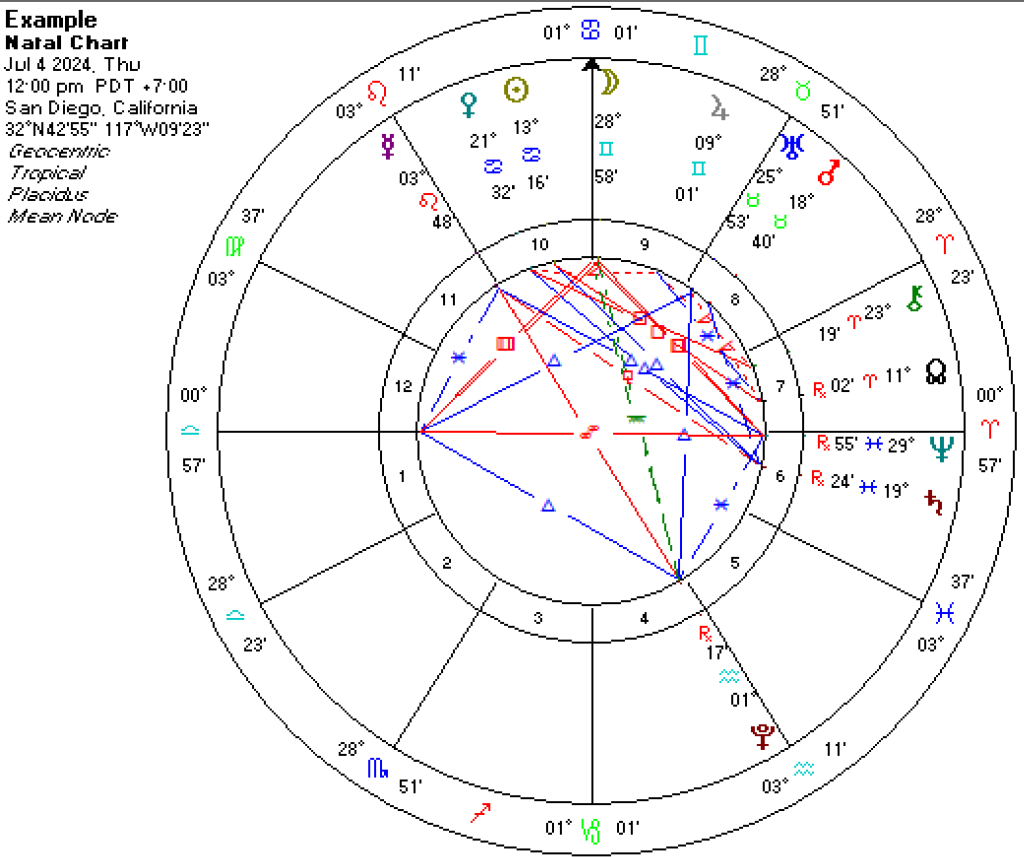
Example A male was born on 7/4/2024 at noon in San Diego.

A basic reading is as follows: Sun in Cancer in the 10th house career, Moon in Gemini in the 9th house of education, Libra ascendant, Moon’s North Node in the 7th house of marriage, etc.
THE SUN IN CANCER
The Sun is in the zodiac sign of Cancer, indicating that a caring and nurturing individual with a strong need for family and comfort will withdraw into his/her shell and home if feeling threatened. This withdrawal can happen quite often due to the person’s emotional reactions. When the person feels an emotional equilibrium, he or she enjoys giving to others, sharing warm and loving moments, and enjoying his/her own company. Their home will be a great source of comfort for your friends and family.
The sun is in the 10th house of the birth chart, meaning that the person likes to make their mark on the world, through their profession. They are also likely to rise to a prominent position in society, perhaps even in government offices. They have high moral standards, which apply to themselves and other people.
THE MOON IN GEMINI
The person has a basic need for mental stimulation. curious and seek answers to many questions. He/she is a chatterbox.
The Moon is placed in the 9th House, suggesting that an idealistic person finds comfort through activities that lift his/her mind above the mundane world and place it in the middle of the realms of imagination, religion, and philosophy. He/she has an inventive mind, and the world of symbols holds great appeal. enjoy traveling, particularly to foreign countries. While some people might have difficulty living out of a suitcase, they enjoy the freedom of being able to escape responsibilities and merge with other cultures.
THE ASCENDANT IN LIBRA
The sign of Libra is considered to be “masculine” by ancient astrologers, suggesting that they are more likely to actively seek purpose in life, taking the initiative rather than waiting until circumstances are comfortable. Libra is also a Cardinal sign, denoting enterprise, enthusiasm, self-assertion, and initiative. They are courteous, affectionate, thoughtful, modest, and indecisive.
Much of life’s purpose is connected with their relationships, both personal and professional. Human relationships are their primary motivation in life. They spend much of their time devoted to thinking about the needs and wishes of other people, ensuring that everyone is fairly treating each other. For this reason, their purpose may be connected with justice, mediation, or diplomatic work.
THE NORTH NODE IN ARIES
This life’s journey is learning to be assertive and self-empowered. They tended to be indecisive, always considering the needs of others first. During this lifetime, they need to discover a sense of their own identity and initiate their projects.
Chinese Numerology and Astrology Are Intertwined
The Chinese numerology and astrology traces back to the New Stone Age or Neolithic Age (12000 years ago) with the tribe’s name “ç‡§äººæ° Fire Making Clan.” They used fire for cooking, produced clay artifacts, astrological and calendar systems such as “10天干 Heavenly Stems” and “12 地支Earthly Branches,” as well as a number and counting system, along with the 5 elements of æ°´ water, 金 metal, ç« fire, 木wood, and 土 soil/earth. The “ä¼ç¾²Fuxi Clan” evolved from the “燧人æ°Fire Making Clan” during the Neolithic period (approximately 4464 B.C.E -3000 B.C.E). Fuxi was the one created to the written language, music notes, instruments, and the early 8å¦ Eight Trigrams, which was one the building blocks of the “Book of Change ” which was written by King Zhou around 1100 B.C.E.
The 10 Heavenly Stems
| Number | 1 | 2 | 3 | 4 | 5 | 6 | 7 | 8 | 9 | 10 |
| Heavenly Stems | é˜é€¢(甲) jiÇŽ | 旃蒙(ä¹™) yÇ | 柔兆(丙) bÇng | 强圉 (ä¸) dÄ«ng | è‘—é›(戊) wù | å± ç»´(å·±) jÇ | ä¸Šç« (庚) gÄ“ng | é‡å…‰(è¾›) xÄ«n | 玄黓(壬) rén | æ˜é˜³(癸) guÇ |
| Yin/Yang | Yang | Yin | Yang | Yin | Yang | Yi | Yang | Yi | Yang | Yi |
| 5Elements | Wood | Fire | Soil/Earth | Metal | Water, | |||||
The 12 earthly branches are based on Jupiter’s interaction with the sun. Jupiter rotates around the sun every 12 years, which is equivalent to one earthly year å²ã€‚
| Earthly Branches | å Zi | 丑 chÇ’u | 寅 yÃn | å¯ mÇŽo | è¾° chén | å·³ sì | åˆ wÇ” | 未 wèi | 申 shÄ“n | é…‰ yÇ’u | 戌 xÅ« | 亥 hà i |
| Hour | 11 pm | 1am | 5 am | 7 am | 9 am | 5 pm | 11 am | 1 pm | 3 pm | 9 pm | 7 pm | 9pm |
| Lunar Months | 11 | 12 | 1 | 2 | 3 | 4 | 5 | 6 | 7 | 8 | 9 | 10 |
| Elements | 阳水 Yang water | 阴土 Yin earth | 阳木 Yang wood | 阴木 Yin wood | 阳土 Yang earth | é˜´ç« Yin fire | é˜³ç« Yang fire | 阴土 Yin earth | 阳金 Yang metal | 阴金 Yin metal | 阳土 Ying earth | 阴水 Yin water |
| Animals | Rat | Cow | Tiger | Rabbit | Dragon | Snake | Horse | Sheep | Monkey | Rooster | Dog | Pig |
“五行:一曰水,二曰ç«ï¼Œä¸‰æ›°æœ¨ï¼Œå››æ›°é‡‘,五曰土。天一生水,天二生ç«ï¼Œå¤©ä¸‰ç”Ÿæœ¨ï¼Œå¤©å››ç”Ÿé‡‘,天五生土 。” in translation is that: The 5 Elements: 1 is Water, 2 is Fire, 3 is Wood, 4 is Metal, 5 is Earth. Heavenly body 1 is Water star Mercury, 2 is Fire star Mars, 3 is Wood Star Jupiter, 4 is Metal Star Venus, and 5 is Eearth as well as Saturn.
Chinese Zodiac: which consists of twelve animal signs: Rat, Ox, Tiger, Rabbit, Dragon, Snake, Horse, Goat, Monkey, Rooster, Dog, and Pig. Each animal sign is associated with certain personality traits and characteristics. Here’s a brief overview of each sign:
- Rat (é¼ – ShÇ”):
- Positive Traits: Quick-witted, resourceful, versatile, charming, intelligent, loves to study and research.
- Negative Traits: Opportunistic, secretive, aggressive at times.
- Ox (牛 – Niú):
- Positive Traits: Diligent, dependable, strong-willed, determined, honest.
- Negative Traits: Stubborn, conservative, hot-tempered.
- Tiger (虎 – HÇ”):
- Positive Traits: Brave, competitive, confident, charismatic, unpredictable, powerful.
- Negative Traits: Impulsive, rebellious, short-tempered.
- Rabbit (å…” – Tù):
- Positive Traits: Gentle, compassionate, modest, diplomatic, sociable, speak for the whole family.
- Negative Traits: Indecisive, overly cautious, superficial.
- Dragon (é¾™ – Lóng):
- Positive Traits: Strong, energetic, charismatic, innovative, passionate, dynamic.
- Negative Traits: Arrogant, tactless, demanding.
- Snake (蛇 – Shé):
- Positive Traits: Wise, intuitive, graceful, analytical, charismatic.
- Negative Traits: Suspicious, jealous, possessive.
- Horse (马 – MÇŽ):
- Positive Traits: Energetic, independent, adventurous, sociable, optimistic, flamboyant.
- Negative Traits: Impatient, hot-headed, rebellious.
- Goat (羊 – Yáng):
- Positive Traits: Gentle, kind-hearted, artistic, sympathetic, creative, persistent.
- Negative Traits: Shy, pessimistic, indecisive, stubborn.
- Monkey (猴 – Hóu):
- Positive Traits: Intelligent, witty, inventive, sociable, enthusiastic, curious.
- Negative Traits: Mischievous, restless, opportunistic.
- Rooster (鸡 – JÄ«):
- Positive Traits: Hardworking, confident, courageous, honest, and organized.
- Negative Traits: Critical, perfectionist, vain.
- Dog (ç‹— – GÇ’u):
- Positive Traits: Loyal, honest, responsible, courageous, protective.
- Negative Traits: Stubborn, anxious, critical.
- Pig (猪 – ZhÅ«):
- Positive Traits: Honest, gentle, generous, optimistic, sincere, fun-loving.
- Negative Traits: Naive, gullible, materialistic.
Chinese numerology is deeply intertwined with cultural beliefs and philosophical principles such as Yin-Yang, the Five Elements (Wu Xing), and the concept of cosmic harmony. It reflects the Chinese worldview of interconnectedness and balance in the universe
Ba Zi å…«å—, also known as “Four Pillars of Destiny,” is a Chinese astrological system that has its origins in ancient Chinese philosophy and metaphysics, particularly within Taoism and Chinese astrology. Its development can be traced back to the Han Dynasty (206 BCE – 220 CE) and earlier, with roots in the I Ching (Book of Changes) and the principles of Yin-Yang and the Five Elements (Wu Xing).
“Four Pillars of Destiny,” is a system that calculates a person’s destiny based on the year, month, day, and hour of birth. Each component represents different aspects of one’s life and personality, influencing career choices, relationships, health, and wealth. Such a date of birth is calculated with the combination of 10 heavenly stems and 12 earthly stems concerning the Five Elements and the Yin-Yang principle.
A human being, like the 5 elements, has 5 major relationships in his life in terms of authority, wealth, parents, siblings, and children. Some are beneficial, some are hurtful, and some could cost him money and rob his wealth. Here are the 5 relationships under the Yin and Yang principle :
- 官 Authority has power over me: æ£å®˜Yang/Governor, ä¸ƒæ€ Yin/General,
- è´¢Wealth is what I conquer and control of: æ£è´¢Yang/right wealth, åè´¢Yin wealth
- å° parents gave birth to me: æ£å° Yang/Right Seal, åå°Yin Seal。
- 窃气 is what I give birth to: 食神Yang/Food God, 伤官 Yin/Hurting Governor
- Siblings: 比肩 Yang/Shouldering together, 劫财 Yin/ Robbing Wealth
In “Four Pillars of Destinyâ€, the year could represent ancestry, the month could represent parents, the date refers to husband and wife, and time represents children.
The male was born on 7/4/2024 at noon in San Diego. The Ba Zi å…«å—:甲辰年 庚åˆæœˆ 己巳日 庚åˆæ—¶
| Ba Zi Chart | Year | Month | Date | Time |
| 公历 Date of birth | 2024å¹´year | 7月month | 4æ—¥date | åˆæ—¶Noon time |
| 天干 Heavenly stem dynamic relation | æ£å®˜ Governor | 伤官 Hurting Governor | 日主 Who I am | 伤官 Hurting Governor |
| Heavenly & Earthly Stem | 甲 Jia è¾° Dragon | 庚Geng åˆHorse | å·±Ji å·³Snake | 庚Geng åˆHorse |
| 地支 Earthly stem dynamic relation | 劫财 Robbing Wealth | åå° Yin Seal. | æ£å° Yang Seal | åå° Yin Seal。 |
| 五行 Wu Xing | 木wood 土earth | 金metal ç«fire | 土earth ç«fire | 金metal ç«fire |
Based on the five elements and the Yin-Yang principle, here is the chat for the person’s general reading. The day he was born reveals his personality traits: He was born with the element of earth but lacked the element of water. Earth symbolizes foundation and stability, while water indicates fluidity. Without the water element, this person may be rigid and unyielding in his personality. The fortunate thing is that there was a fire element on the day he was born, which is extremely beneficial to him.
Being born in the year of the dragon implies that the individual is fearless and driven by a strong sense of enterprise; focused and decisive, willing to take action; filial, generous, and skilled at managing finances; clever, talented, and has a dignified manner. Intelligent and talented, dexterous and quick-witted, with some success in one’s work pursuits. who is upright and straightforward, unaffected by others’ opinions, wealthy and resourceful, but far from close family. By relying on his judgment and efforts, he might achieve greater success later in life, leaving a successful family legacy. He comes from a scholastic or civil service family background. As for his future wife, who could be very kind and caring,. As for his children, his firstborn might be a daughter.
Human Design is a metaphysical system that combines principles from astrology, the I Ching, Kabbalah, the chakra system, and quantum physics. It was developed by Ra Uru Hu (Robert Allan Krakower) in 1987 after what he described as a mystical experience. Here are the key components of human Design:
- Body Graph: The central tool of Human Design is the Body Graph, a visual representation of a person’s energetic system. It combines elements from astrology (planets and signs), the I Ching (hexagrams), and the chakra system.
- Types: Human Design categorizes individuals into five main Types based on how their energetic system interacts with and responds to the world:
- Manifestors: Initiators who can directly impact and initiate action.
- Generators: Energetically responsive and make up the majority of the population. They have sustainable energy when doing what they love.
- Manifesting Generators: A hybrid of Manifestors and Generators, with both initiating and responsive energies.
- Projectors: Guides and advisors who have the ability to recognize and direct the energies of others.
- Reflectors: Rare individuals who are highly sensitive to the energies around them and reflect the health of their environment.
- Centers and Channels: The Body Graph includes various Centers (analogous to chakras) and Channels (connections between Centers) that represent different aspects of a person’s psychological and energetic makeup.
- Authority: Each individual has a defined Authority, which is the center in the Body Graph that governs their decision-making process. Authorities include Emotional, Sacral, Splenic, and others, and each has a specific way of guiding an individual towards making correct decisions aligned with their design.
- Profiles: Profiles in Human Design are derived from the positions of the Sun and Earth at the time of birth and provide insights into an individual’s life purpose and role in the world.
- Strategy and Authority: Together, Strategy (how to interact with the world) and Authority (how to make decisions) guide individuals in living according to their unique design and finding fulfillment and success.
Human design is used for self-discovery, personal growth, and understanding one’s inherent strengths and challenges. It provides a framework for individuals to align with their authentic selves and make decisions that are in harmony with their energetic makeup.
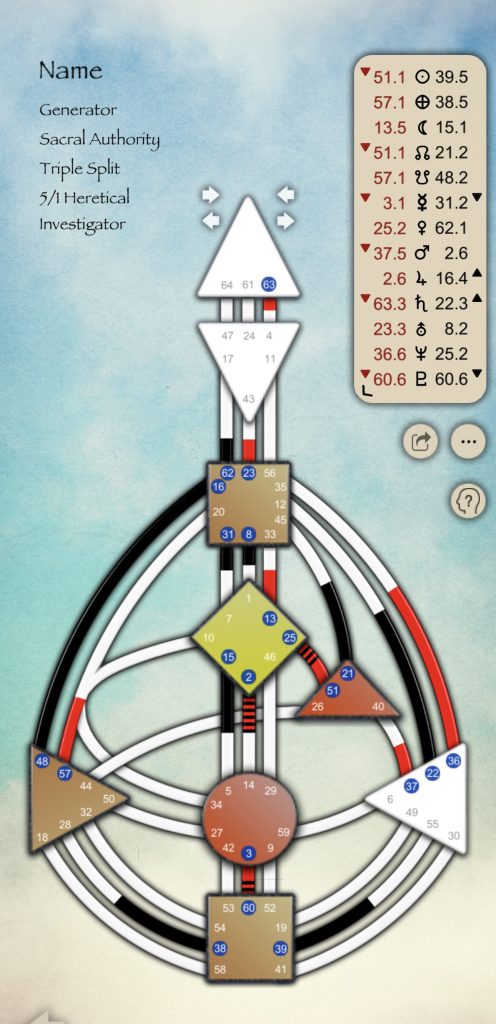
the same person was born on 7/4/2024 at 12:00 pm San Diego
Generator: the life force of the planet and is here to work on what makes him satisfied. The defined sacral center generates unlimited energy as long as he uses it correctly. With 6 defined energy centers in the 9-centered being, he very much knows where he is headed in life—solid, not emotional. If he honors his inner knowing, intuition, and inner guidance, he can easily move through the journey of life with easy.
Sacral Authority: indicates his energy is generated from his 2nd chakra, where he needs to respond to Ah-huh (yes), Nah-hun (no), and Hmm (maybe, I don’t know) sounds of his sacral center to generate energy in response to others projection.
5/1 Heretic Investigator Profile: Unconscious Line 1 represents the authoritative foundation, joining line 5 of I Ching, which consciously projects all that foundation could or should be. this is why he is a most transpersonal profile of saviors and generals, or trickery and paranoia. Line 5 is in the position of generals and leaders, the ruling class. Trans-personal Destiny means a person is here to deal with Karma, and is designed to have encounters with others to make changes and transformations. The universe will create opportunities for him to meet people has a karmic relationship with to help them transform and change.
Numerology
Numerology is a belief system and practice that involves the study of numbers and their mystical or symbolic meanings, its meaning can influence various aspects of human life. numerology has roots in ancient civilizations such as Chinese, Babylon, Egypt, Greece, and India.
Chinese numerology, linguistically speaking.
- Number1, 一 yi, unity, beginning, heaven
- Number 2, 二er, pair, balance, cooperation.
- Number 3, 三 san, growth, creativity, rise, life
- Number 4, 四si, death, unlucky number
- Number 5, 五wu, change, transformation, five elements.
- Number 6, å…liu, smooth, well-being,
- Number 7, 七qi, together, spirituality, mysticism.
- Number 8, å…«ba, prosperity, wealth, prosper, luck number for business and personal endeavors.
- Number 9,ä¹ jiu, longevity, eternity.
Western Numerology
The Greek Philosopher Pythagoras ( 570- 495 B.C.E.) is often credited with being one of the early proponents of numerology in the Western world. He believed that numbers were the fundamental elements of the universe, and they had intrinsic qualities and vibrations.
Pythagorean numerology remains popular today as a method for individuals to gain deeper self-awareness and guidance, exploring the symbolic meanings and vibrations associated with numbers to understand their life paths and potentials. Key principles and features of Pythagorean numerology include:
- Single-Digit Numbers:
- Pythagorean numerology primarily focuses on single-digit numbers from 1 to 9. Each number is believed to have distinct qualities and characteristics.
- Birth Date Calculation:
- A core component of Pythagorean numerology involves calculating the Life Path Number, which is derived from a person’s date of birth. This number is considered fundamental and represents the path or journey that an individual is destined to follow in life.
- Name Analysis:
- Pythagorean numerology also analyzes the numerical value assigned to letters in a person’s full birth name. By converting each letter into a number (based on its position in the alphabet) and then summing these values, numerologists derive the Expression Number (also known as Destiny Number). This number is believed to reveal innate talents, abilities, and potential challenges associated with one’s name. Soul Urge Heart Desire number, based on the vowels in a person’s birth name, reflects inner desires and motivations. Personality Number: calculated from the consonants in a person’s birth name, this number represents outward behavior and how others perceive the individual.
| 1 | 2 | 3 | 4 | 5 | 6 | 7 | 8 | 9 |
| A | B | C | D | E | F | G | H | I |
| J | K | L | M | N | O | P | Q | R |
| S | T | U | V | W | X | Y | Z | |
- Characteristics of Numbers: Each number in Pythagorean numerology is associated with specific traits and attributes. For example:
- Number 1: Independence, leadership, innovation, ambition, individuality.
- Number 2: Cooperation, harmony, diplomacy, sensitivity, partnership.
- Number 3: Creativity, self-expression, communication, optimism, socialization.
- Number 4: Stability, practicality, hard work, organization, reliability.
- Number 5: Freedom, adventure, change, versatility, unpredictability.
- Number 6: Responsibility, harmony, love nurturing, service
- Number 7: Spirituality, introspection, wisdom, analysis, solitude.
- Number 8: Ambition, success, power, material wealth, authority.
- Number 9: Compassion, humanitarianism, idealism, universal love, endings.
- Master number 11: Spiritual enlightenment, intuition, inspiration, idealism.
- Master number 22: “Master Builderâ€, practical idealism, manifesting dreams into reality.
- Master number 33: “Master Teacher†signifies compassion, blessing, healing, deep desire to uplift humanity and contribute to the great good.
Here’s a brief overview of what each number typically represents in numerological interpretations:
- Number 1:
- Meaning: Independence, leadership, innovation, ambition, individuality.
- Positive Traits: Initiative, assertiveness, determination, originality.
- Negative Traits: self-centeredness, stubbornness, and impatience.
- Number 2:
- Meaning: cooperation, harmony, diplomacy, sensitivity, partnership.Positive Traits: Compassion, intuition, teamwork, and adaptability.
- Negative Traits: indecisiveness, dependency, oversensitivity.
- Number 3:
- Meaning: creativity, self-expression, communication, optimism, socialization.Positive Traits: Artistic talent, enthusiasm, joyfulness, and humor.
- Negative Traits: Scattered energy, superficiality, gossip.
- Number 4:
- Meaning: stability, practicality, hard work, organization, reliability.Positive Traits: Discipline, loyalty, patience, and attention to detail.
- Negative Traits: Rigidity, stubbornness, lack of imagination.
- Number 5:
- Meaning: freedom, adventure, change, versatility, unpredictability.Positive Traits: Resourcefulness, adaptability, curiosity, and dynamic.
- Negative Traits: restlessness, impulsiveness, irresponsibility.
- Number 6:
- Meaning: responsibility, nurturing, harmony, love, service.Positive Traits: compassion, generosity, family-oriented, stability.
- Negative Traits: overly protective, self-righteousness, meddling.
- Number 7:
- Meaning: spirituality, introspection, wisdom, analysis, solitude.Positive Traits: Perceptive, analytical, intuitive, and studious.
- Negative Traits: Aloofness, skepticism, withdrawal.
- Number 8:
- Meaning: ambition, success, power, material wealth, authority.Positive Traits: Business acumen, leadership, decisiveness, and efficiency.
- Negative Traits: Ruthlessness, materialism, workaholism.
- Number 9:
- Meaning: Compassion, humanitarianism, idealism, universal love, endings.
- Positive Traits: Generosity, empathy, artistic talent, selflessness.
- Negative Traits: Martyrdom, self-pity, impracticality.
Master Numbers:
- Number 11:
- Meaning: spiritual enlightenment, intuition, inspiration, idealism.Positive Traits: Visionary, empathetic, insightful, and inspirational.
- Negative Traits: nervousness, impracticality, overwhelm.
- Number 22:
- Meaning: Master builder, practical idealism, manifesting dreams into reality.
- Positive Traits: Visionary leadership, pragmatic approach, efficiency.
- Negative Traits: Overwhelm, perfectionism, rigidity.
- Number 33:
- Meaning: Master teacher, compassion, healing, nurturing, humanitarianism.
- Positive Traits: Universal love, selflessness, creativity, guidance.
- Negative Traits: Overly emotional, impractical idealism.
Example for the same person born on 7/4/2024.
He has life path number 1, indicating he is independent, interested in leadership roles, ambitious, and creative. He wants to be #1 in whatever he does and can be very competitive; however, he can be stubborn if he does not have an open mind or emotional compassion for others.


 English