
The Art of Living
Ancient Wisdom
Feng Shui (风水) is a profound and ancient Chinese philosophy that focuses on harmonizing the energies of our environment to enhance our well-being, prosperity, and health. The term “Feng Shui” is derived from two Chinese characters: “Feng” (风), meaning wind, and “Shui” (水), meaning water. In this practice, wind and water symbolize the natural forces that move and flow through the world—forces that directly influence the flow of Qi (气), the vital life energy that pervades all living things.

What is Qi and How Does It Relate to Feng Shui?
At the heart of Feng Shui lies the concept of Qi—the invisible life force or energy that flows through the universe, manifesting in all forms of existence. Qi is similar to the modern scientific concept of energy and can be seen in phenomena like electrical currents, magnetic fields, and even quantum fields. Just as electricity flows through wires, Qi flows through spaces, individuals, and the earth. The goal of Feng Shui is to guide the flow of Qi in a way that benefits human life—by ensuring that it is harmonious, balanced, and abundant.
In the world of Feng Shui, Qi is seen as either rising or falling. 生气(sheng qi) refers to rising Qi, which is often associated with prosperity, vitality, and good fortune. On the other hand, 死气 (si qi), or declining Qi, is considered harmful and stagnating. It is believed that through correct Feng Shui practices, you can influence the environment to attract more sheng qi and eliminate or redirect si qi, thereby creating a more favorable life experience.
The Foundation of Feng Shui: The Bagua 八卦
Feng Shui’s roots trace back to ancient Chinese texts, particularly “The Book of Change” , which is the foundation for understanding the flow of energy in the natural world. One of the most important aspects of this ancient knowledge is the Bagua (八卦), also known as the Eight Trigrams. The Bagua consists of eight symbols, each representing a different natural phenomenon that is believed to influence the world and our lives.
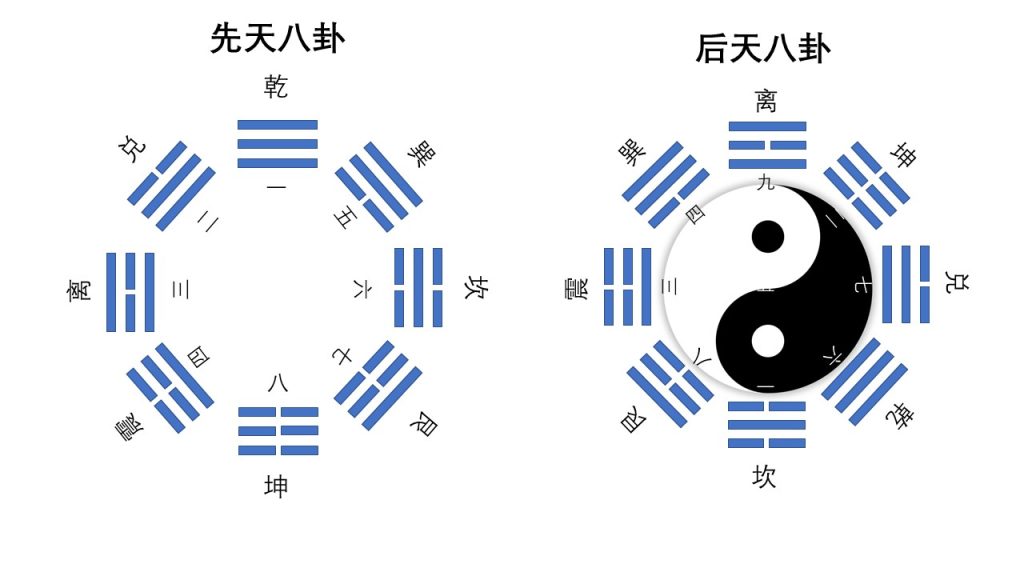
The Eight Trigrams (Bagua) and Their Evolution in Feng Shui
In the practice of Feng Shui, the Bagua (八卦), or Eight Trigrams, plays a central role in understanding and optimizing the flow of energy (Qi) in the environment. The trigrams consist of three lines that can either be unbroken (yang) or broken (yin), with each trigram symbolizing a specific natural force or element that influences both the physical world and human experiences. These trigrams are combined to create a set of symbols that serve as a map for navigating energy and determining the alignment of a space.
However, there are two main Bagua systems that are important in the study of Feng Shui: the Early Bagua and the Later Bagua, both of which have distinct origins and applications. Each system serves a unique purpose and reflects different philosophical ideas about the relationship between Heaven, Earth, and humanity.
The Early Bagua (先天八卦)
The Early Bagua, also known as the Heavenly Bagua, originates from the ancient Daoist philosophy and was traditionally associated with the Yellow Emperor and early cosmological understanding. It is believed to reflect the fundamental, primal forces of the universe in their purest form.
- The Structure: The Early Bagua consists of eight trigrams that represent the primordial forces that make up the universe. Each trigram in the Early Bagua is related to an essential aspect of the world and humanity’s relationship with nature. This arrangement is more abstract, focusing on cosmic forces and their balance.
- The Eight Trigrams in the Early Bagua:
- Heaven (乾) – Represents strength, creativity, and leadership.
- Lake (兑) – Linked to joy, creativity, and emotional fulfillment.
- Fire (离) – Associated with passion, transformation, and energy.
- Thunder (震) – Represents movement, action, and power.
- Wind (巽) – Symbolizes communication, change, and flexibility.
- Water (坎) – Denotes fluidity, adaptability, and flow.
- Mountain (艮) – Stands for stillness, peace, and meditation.
- Earth (坤) – Symbolizes nurturing, stability, and grounding.
- The Eight Trigrams in the Early Bagua:
In the Early Bagua system, these trigrams were initially seen as symbolic of cosmic and elemental forces that guide natural phenomena, rather than directly influencing human experience.
The Later Bagua (后天八卦)
The Later Bagua, which is more commonly used in Feng Shui practice today, was developed during the Zhou Dynasty (1046–256 BCE) and later refined by scholars and Feng Shui masters. The Later Bagua represents a shift in focus from abstract cosmic forces to the practical application of energy in the human environment. This system is grounded in the philosophy of balance between Heaven and Earth, with the Heavenly trigrams now understood as the “father” and the Earthly trigrams as the “mother.”
- The Structure: The Later Bagua arranges the eight trigrams in a grid or map, where each trigram corresponds to a specific area of life and a particular direction in the environment. This system reflects the dynamic interactions between Heaven (yang) and Earth (yin), and how their energies can be balanced to produce favorable outcomes in human life. The Later Bagua’s primary purpose is to influence the flow of Qi in spaces and to optimize harmony, health, and prosperity.
- The Eight Trigrams in the Later Bagua:
- Kan (坎) – Water – Denotes wisdom, mystery, and adaptability (North).
- Kun (坤) – Earth – Symbolizes nurturing, stability, and support (Southwest).
- Zhen (震) – Thunder – Represents action, movement, and initiative (East).
- Xun (巽) – Wind – Symbolizes growth, flexibility, and communication (Southeast).
- Center
- Qian (乾) – Heaven – Represents leadership, authority, and creativity (Northwest).
- Dui (兑) – Lake – Linked to joy, creativity, and completion (West).
- Gen (艮) – Mountain – Represents stillness, meditation, and stability (Northeast).
- Li (离) – Fire – Associated with passion, transformation, and clarity (South).
- The Eight Trigrams in the Later Bagua:
In this system, each trigram is mapped to a specific sector of your home or office space, and understanding their relationships can help optimize energy flow, creating balance and harmony in both your physical surroundings and personal life.
Heaven and Earth: The Father and Mother in Feng Shui
In the Later Bagua, the relationship between the Heavenly trigrams and Earthly trigrams is akin to that of father and mother. Heaven (represented by the trigrams of Qian ) symbolizes the active, creative force, while Earth(represented by the trigrams of Kun ) embodies the nurturing, supportive energy. This concept highlights the duality of forces in nature—yang and yin—and how they interact to create a dynamic and harmonious system.
In this interpretation, Heaven is not a direct ruler, but rather an overarching influence or guide that, together with Earth, provides the foundation for life. The harmony between these two forces, often referred to as the balance of yin and yang, is essential in Feng Shui practice, as it governs the flow of Qi in any environment.
The Evolution of the Bagua in Feng Shui
Over time, the system of the Bagua has evolved and been refined to suit the needs of Feng Shui practitioners. Today, the Later Bagua is the dominant system used in practical applications of Feng Shui, whether it’s in the design of buildings, the arrangement of furniture, or even the flow of energy during specific times and seasons. The Early Bagua, with its more abstract and cosmic associations, is still revered in Daoist philosophy and spiritual practices but has less direct application in Feng Shui’s everyday use.
The fusion of Heaven’s active creative force and Earth’s nurturing energy gives rise to a balanced, harmonious environment where Qi can flow freely and positively impact the lives of individuals. Whether you’re seeking prosperity, health, or happiness, the principles of the Later Bagua offer valuable guidance for creating spaces that align with the natural rhythms of the universe.
The Dimensions of Bagua: Exploring the Depths of Feng Shui
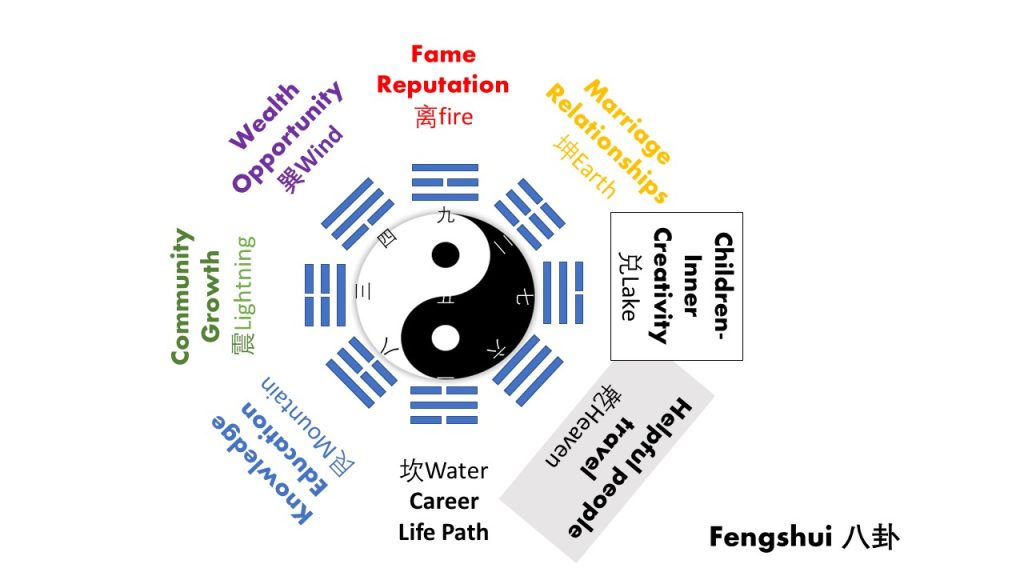
The Bagua is not merely a two-dimensional map; it exists in multiple dimensions, each offering a different layer of understanding.
- 2D: The Bagua can be laid out as a map on the floor of your living or working space, with each trigram representing an area or aspect of life (such as wealth, health, relationships, and career). This layout helps to align your physical environment with the flow of energy.
- 3D: In addition to its 2D plane, the Bagua also extends into a three-dimensional orientation, influencing how the energy of your space interacts with you on a physical level. This includes the arrangement of furniture, the placement of windows and doors, and the balance of elements in the room.
- 4D and Beyond: Feng Shui principles extend into time and space, influencing both the timing of actions (when to sign contracts, begin new projects, etc.) and the way the environment interacts with you over time. In the 4Dcontext, Feng Shui becomes a tool to navigate the flow of energy through time. In more advanced Feng Shui, dimensions like 5D parallel universes and 6D (64 Gua) come into play, adding layers of complexity to how energy is harnessed for success and well-being.
Fengshui derives from Zhou Yi周易 – “the book of Zhou” or ” the book of change” . The Chinese character Zhou 周 translates to “cycle,” “circumference,” and “whole.” This reflects the cyclical nature of time and energy, which is central to the practice of Feng Shui. Just as the seasons cycle through the year, energy in your space flows through cycles as well. Understanding and working with these cycles is a key element of Feng Shui practice.
The Role of Space-Time Orientations in Feng Shui
At the core of Feng Shui is the idea that energy (Qi) flows through both space and time. By orienting your space properly, you can optimize the flow of Qi and create a more harmonious environment. This includes the strategic placement of objects, furniture, and even the design of the space itself. Feng Shui uses these space-time orientations to:
- Govern Energy Flow: This involves understanding how energy moves through a space and ensuring that it flows freely without obstruction. The placement of doors, windows, and furniture is critical in directing this flow of Qi.
- Achieve Harmony and Balance: Feng Shui aims to create an equilibrium between the five elements—wood, fire, earth, metal, and water—each of which corresponds to a different aspect of life. For instance, water symbolizes wealth, while wood represents growth. Balancing these elements leads to an environment that supports both personal and professional growth.
- Produce Desirable Results: By aligning your environment with favorable Qi, Feng Shui practitioners believe you can manifest prosperity, health, career success, and happiness. This can be achieved through simple changes in your environment, such as adding certain colors or elements to a room or rearranging furniture to improve energy flow.
A Holistic Approach
Ultimately, Feng Shui is not merely a system of rules but an art of living—a way to create environments that nurture and enhance your life force. By aligning your physical surroundings with the natural energies of the universe, you can bring peace, prosperity, and health into your life.
The practice of Feng Shui extends beyond just interior design; it’s about being mindful of how we live in our spaces, how we interact with the environment, and how we harness energy to achieve personal and collective goals. Whether you are looking to increase your wealth, improve relationships, or enhance your well-being, Feng Shui offers a roadmap to creating an environment that supports your highest potential.
The BOOK OF CHANGE is the ancient wisdom entails humanity’s multidimensional journey.
What does Feng Shui help with?
Fengshui can assist with many aspects of your home and business. Here are a few examples:
a. Home Fengshui . Your home environment is critical for your business, marriage, relationship, fame, fortune, health, and success. If you are experiencing problems in any of the above sectors, it may be time to seek fengshui services.
b. Buy or Sell Real Estate: Whether you are a real estate broker or the property owner, it is best to have a fengshui master inspect the property before making a large investment. A person's date of birth determines which location and orientation of a property are most appropriate and auspicious for that person.
c. Businesses such as restaurant and offices of lawyers, accountants, psychologists, professional trainers, doctors, etc. A fengshui master can provide suggestions and adjustments for success and prosperity, and so on, by examining the business structure, orientation, traffic flow, setting, and product display.
d. Coroperation: A corporation consists of many departments and heads, each with its own operating energy level. Analyzing the company in terms of marketing and sales, brand, operations, services and goods, resources, customer service, market competition, and leadership, and offering suggestions for improvements. Check out the blog tips regarding office fengshui
e. Executive: Designed for busy executives looking to improve their overall health, success, and happiness.
f. Individual fengshui: The human body is comprised of spiritual, mental, emotional, and physical bodies. A fengshui master can aid you in aligning with your maximum potential and wealth by evaluating the flow of energy.

Subscribe to YouTube for more Feng Shui tips.
Call (858)888-1369
or email elly@zempowerment.com
 English